Disclaimer: Originally published here https://techeconomist.hashnode.dev/it-is-more-than-a-blockchain-lessons-from-a-agriculture-traceability-project. Due to personal reasons, this blog has been relocated here.
Between 2020-2023 I led a donor-funded project on Private Sector Development. I was heavily involved in a dedicated component for Organic Agriculture Development in a South Asian country. One of our main goals was to transform smallholder farmers’ access to international markets. We worked on capacity building on market access, obtaining organic certifications and building digital solutions to elevate the farmers. Blockchain technology was gaining traction, coming out as a way to increase trust, security, immutability and transparency in data recording.
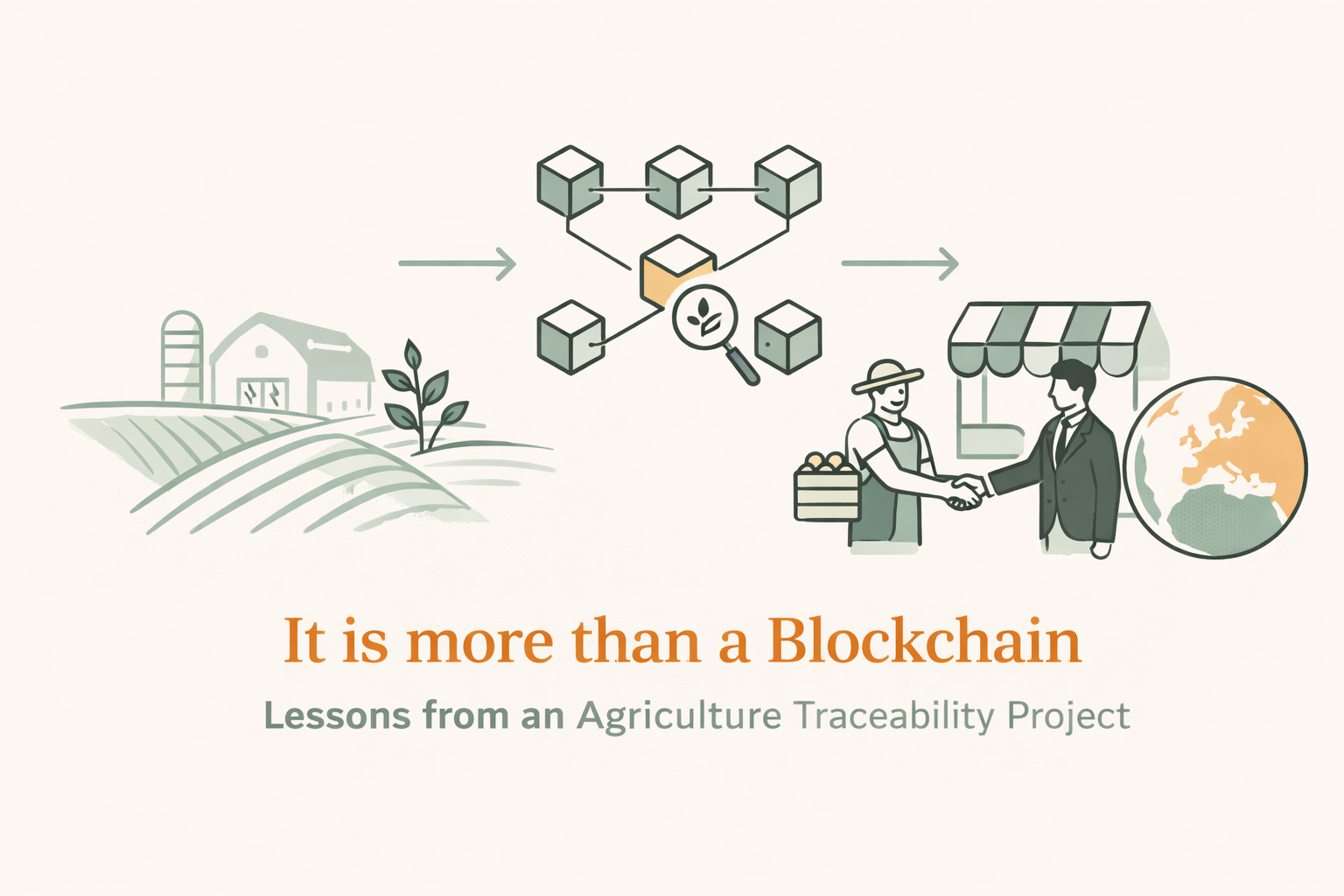
Our proposal was straightforward. Use Blockchain technology to create transparency, through smart contracts that would enable fair pricing, and to bridge the gap between rural farms and premium organic buyers in Europe. Looking back from 2026, we now live in a world where we see a pattern repeating across agricultural traceability projects worldwide. The technology works in pilot projects, but scaling to real-world adoption remains frustratingly elusive.
Blockchain Success Stories: What Works
In a world of mistrust especially regarding food, Walmart partnered with IBM to trace mangoes. They have reported that they managed to reduce the trace back time from 7 days to 2.2 seconds. The solution was built on Hyperledger Fabric, an open-source digital ledger technology running on IBM Cloud. Started off as an answer to ensure food safety issues, Walmart piloted the project as an answer to reduce trace time in case of a food poisoning outbreak might occur. As of 2026, the company is further augmenting this blockchain foundation with Agentic AI and automated supply chain centers to predict demand and reduce waste at scale.
In another part of the world, TraceX in India works with thousands of farmers, partnering with major brands like MTR Foods and Blue Tokai Coffee. They were able to expand the pilot project to 4000 farmers in Araku Valley. TraceX has expanded the same blockchain architecture in to other industries as well; poultry, milk and seed traceability.
These success stories have a few thing in common
- Strong anchor buyers – Walmart funded its own initiative driven by food safety concerns, while TraceX secured funding from major brand partnerships
- Strong consumer demands – Walmart consumers and the other luxury brand consumers.
- Strong participation throughout the supply chain – Every stakeholder in the assignment understood the incentive on having a clear, transparent, immutable record system.
- Robust technical support – TraceX raised their own capital to develop the technology and IBM came through with a strong system
Can it fail? Yes. But replicating these conditions is exactly where most projects struggled.
Challenges all the way
There are three main challenges that we faced during our implementation. And same can be said for the many blockchain integration in to supply chain.
- The Participation Paradox
Very early on we encountered an issue. The wholesale buyers of smallholder farmers, who have a stake in the organic agriculture value chain did not want to participate in the shared database. Although simulations were run to counterpoint and show the security of their data, they strongly disagreed to be part of the project. From their point of view, in a red ocean this is not paranoia, this is experience. This review article in ScienceDirect also mention lack of standardization and participation barriers are the primary challenges in implementing digital traceability.
Blockchain relies on network participation. This cannot be achieved if there is competitor mistrust.
- Missing links and data errors
In our project, digital literacy was not an issue, however there was reluctance in entering data. They didn’t see the incentive of putting extra effort. We prepared to delegate the work to agriculture extension officers. This led to discovery of another critical vulnerability; blockchain is only as trustworthy as the person entering data at the source.
In many cases not so thrilled small holder farmers, suppliers, to technically un-savvy stakeholders in a value-chain could be costly (onboarding and training) and cumbersome. Despite their success, Walmart faced the same challenge.
- Disconnection in sharing the value
Price premium was our hook to get the stakeholders involved. Traceability complemented the organic certification process that we had begun several years back. Therefore we were fortunate. But this could easily be a challenge for many other projects. Premiums existed only in urban niche markets, requiring long-term investment beyond certain project timelines.
This pattern extends beyond organic agriculture. According to a ScienceDirect Article of Aquaculture and Blockchain
The majority of the blockchain use cases are for traceability and storytelling, and to a lesser extent for payments or incentives
There is still work to do
For blockchain technology this is just the start. We have success stories and we have lessons that we learnt. I remain convinced blockchain offers the best path forward for food supply chain transparency and equitable value distribution. But technology alone isn’t the answer.
How national policy can help?
Our project revealed a critical policy gap: the absence of a national organic standard meant blockchain could verify data integrity but couldn’t establish certification legitimacy. Throughout our programme period there was no centralised national organic standard. We saw although Blockchain could verify data integrity but couldn’t establish what organic certification actually meant or who had authority to grant it.
What could the policy environment could look like?
- Clear certification frameworks: National standards defining what blockchain verifies
- Incentive alignment: Price premiums, market access, or reduced costs rewarding participation
- Digital infrastructure: Basic connectivity before demanding real-time IoT data
- Capacity building: Ongoing support for extension officers bridging the digital divide
The question for policymakers in emerging markets isn’t whether to adopt blockchain. The focus should be on foundational policies, infrastructure, and incentive structures exist to make adoption viable beyond pilots. Because without those foundations, we’re just creating more expensive ways to confirm what we already knew: the technology works beautifully, but the ecosystem isn’t ready.
As for a way forward, pilot projects serve their purpose: they teach us, we iterate, we improve. But what all these pilots have taught us is one thing: for blockchain technology to truly achieve its potential in agriculture, we need strong policy foundations that make scalability possible, not just more proof-of-concepts.
Glossary
Agentic AI – autonomous systems that go beyond generating content to proactively set goals, plan, and execute complex, multi-step tasks with minimal human oversight
Hyperledger Fabric – permissioned distributed ledger technology (DLT) platform designed for enterprise use
Sources
- Walmart bets big on AI – Talk Business, February 2026
- TraceX Case Studies
- Blockchain in Agriculture – Farmonaut, June 2025
- Walmart blockchain challenges – PYMNTS, December 2022
- Aquaculture blockchain use cases – ScienceDirect
- Blockchain traceability barriers – ScienceDirect, November 2024
Leave a Reply